
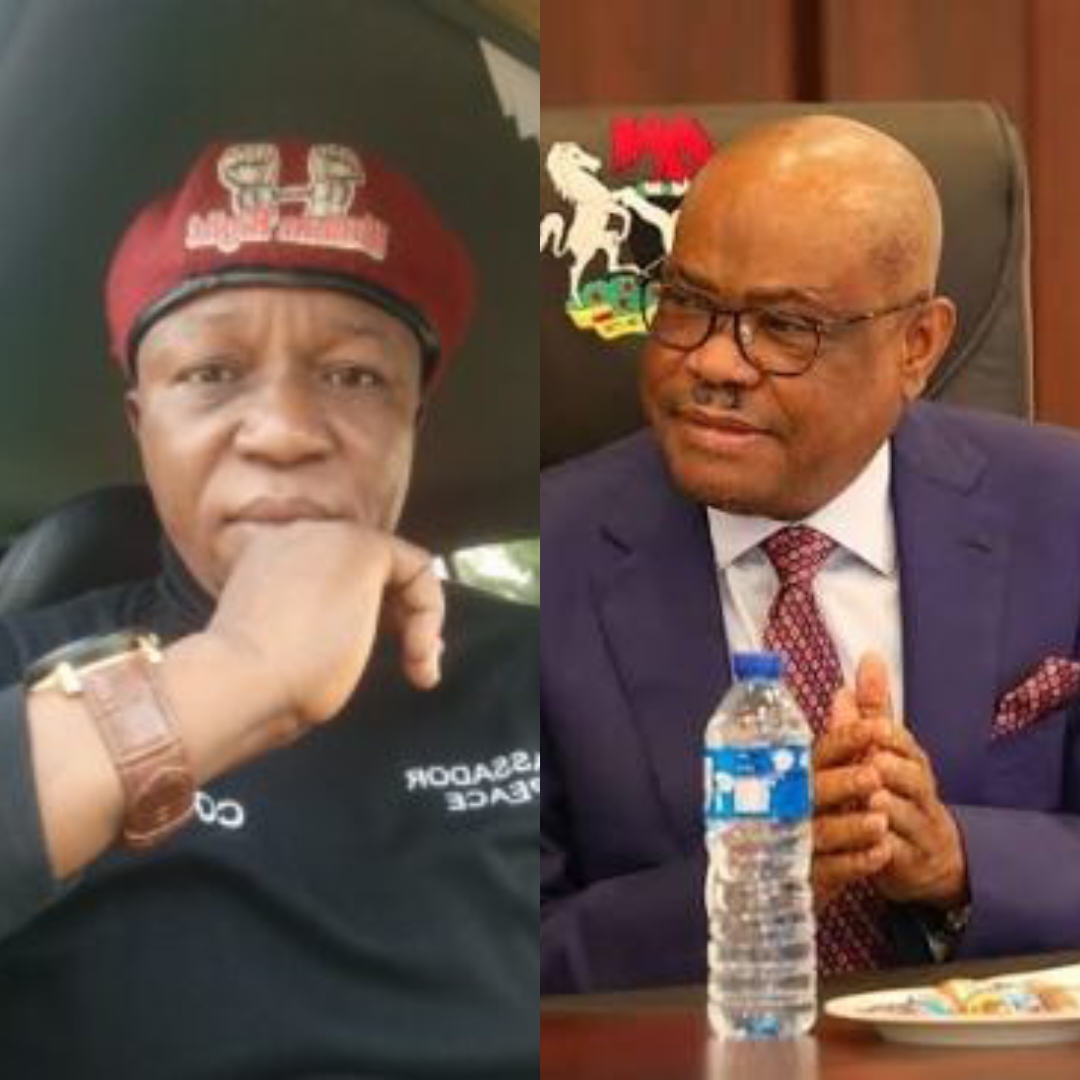
What Did Wike Mean? Iche Seeks Security Agencies’ Intervention Over ‘Producing Candidates Anywhere’ Comment
By Naomi Onome
Human rights advocate, Comrade Prince Saviour Iche, has called on Nigeria’s security agencies to invite the Minister of the Federal Capital Territory, Nyesom Wike, for questioning over remarks attributed to him concerning the ability of his political group to produce candidates for elections.


Iche, who expressed concern over the implications of such statements for Nigeria’s democratic process, said security agencies should not overlook comments by influential political actors when such remarks appear to suggest an ability to determine electoral candidates outside established democratic procedures.
His reaction followed remarks attributed to Wike in which the FCT Minister spoke about the political capacity of his group to produce candidates in different parts of the country. Recent reports have also documented Wike’s involvement in political efforts surrounding the 2027 elections, including his support for candidates associated with his faction of the Peoples Democratic Party (PDP).
According to Iche, statements suggesting that politicians can determine who emerges as candidates could create public concern about the credibility of the electoral process, particularly at a time when political parties are preparing for the 2027 general elections.
He argued that, if such remarks are interpreted as suggesting the imposition of candidates or undue influence over the electoral process, the appropriate authorities should seek clarification from the speaker.
“His statement signals to Nigerians and the world that there is no such thing as a free and fair election,” Iche said, urging the security agencies to invite Wike to explain what he meant.
The human rights advocate maintained that Nigeria’s democratic institutions must be strong enough to subject politically influential individuals to the same standards applicable to other citizens.
He further questioned why Wike, despite his complex political relationship with the PDP and his association with the administration of President Bola Ahmed Tinubu, has continued to wield considerable influence across political structures.
Wike has publicly explained his political activities as part of efforts to prevent politicians who lost nomination opportunities from moving to opposition platforms that could work against President Tinubu in 2027. In a recent media engagement, he defended his decision to support lawmakers who lost their APC tickets to contest on the platform of his PDP faction, arguing that doing so would keep them within a political structure supportive of the President.
Iche, however, said such political manoeuvring should not be allowed to undermine the principle that candidates should emerge through transparent and constitutionally recognised party processes.
His comments come amid continuing disputes within the PDP and disagreements over the authority of different factions to conduct primaries and produce candidates ahead of the 2027 elections.
For instance, reports have emerged of competing factions producing candidates in some states. In Plateau State, a Wike-backed faction conducted a governorship primary that produced Chief Kefas Wungak Ropshik, widely known as Kefiano , while another faction of the PDP moved separately to affirm Sunday Garba Biggs as its candidate.
Similarly, in Bauchi State, competing PDP structures have produced different candidates, further illustrating the extent of the party’s internal crisis ahead of the next general elections.
Iche said developments of this nature make it imperative for political parties and state institutions to uphold procedures that guarantee transparency, internal democracy and respect for the electorate.
This is another opportunity to own a faster-loading website to expand your business and take it digitally online. Meet the best website designer/master coder for any kind of website. Contact them now it is affordable Chat now: 09077260922
He also questioned the purpose of substantial public expenditure on electoral institutions if powerful political actors could openly boast about their ability to determine candidates before voters have the opportunity to make their choices.
The activist stressed that Nigeria’s democratic institutions must protect the right of citizens to participate in elections where candidates are selected through recognised party processes and ultimately subjected to the decision of voters.
According to him, no individual politician, regardless of political influence or access to government, should be regarded as being above scrutiny.
“Let it be known to Wike that he is not a god; he is just a mortal man,” Iche said, warning political leaders against conduct that, in his view, could have a negative influence on younger Nigerians.
He also urged the All Progressives Congress (APC) to pay attention to statements and political activities capable of generating controversy around the administration of President Tinubu.
Iche argued that Wike’s continued prominence in political calculations could expose the administration to criticism, particularly where his actions or statements are perceived as inconsistent with the expectations of transparent democratic governance.
Wike’s political role has in recent months extended beyond his formal position as FCT Minister, with his influence also evident in negotiations and political alignments involving the PDP and the 2027 elections. In April 2026, a Wike-backed PDP leadership said the party was preparing to conduct credible primaries and produce candidates ahead of the general elections.
However, the continuing factional disputes within the PDP have also generated competing claims over which structures possess the legitimate authority to produce candidates.
Against this background, Iche called on relevant authorities to ensure that political influence does not replace established electoral and party procedures.
He said Nigerians deserve an electoral system in which political parties conduct transparent primaries, electoral institutions perform their statutory responsibilities independently, and voters retain the final authority to determine who occupies elective positions.
Iche further warned that political statements made by powerful actors should be examined carefully because they can influence public confidence in democratic institutions.
He therefore urged the security agencies and other relevant authorities to obtain clarification from Wike on the meaning and implications of his remarks, rather than allowing the controversy to fester.
The human rights advocate said Nigeria’s democracy could only be strengthened when institutions apply the law and established rules equally, irrespective of the political status of individuals involved.
As preparations intensify for the 2027 general elections, the controversy highlights the broader debate over internal party democracy, candidate selection, political influence and the ability of Nigerian institutions to guarantee a credible electoral process.
Iche maintained that the ultimate responsibility for choosing elected representatives should remain with Nigerian voters and not with individual political power brokers.



Leave a Reply