
‘Insure Lives, Not Just Cars and Gold’: Stakeholders Push for Urgent Expansion of Health Insurance as Millions of Nigerians Face Medical Poverty
By Naomi Onome
Healthcare leaders, policymakers, pharmacists and industry experts have called for an urgent expansion of health insurance coverage in Nigeria, warning that millions of citizens remain vulnerable to medical poverty because they still pay for healthcare largely from their own pockets.


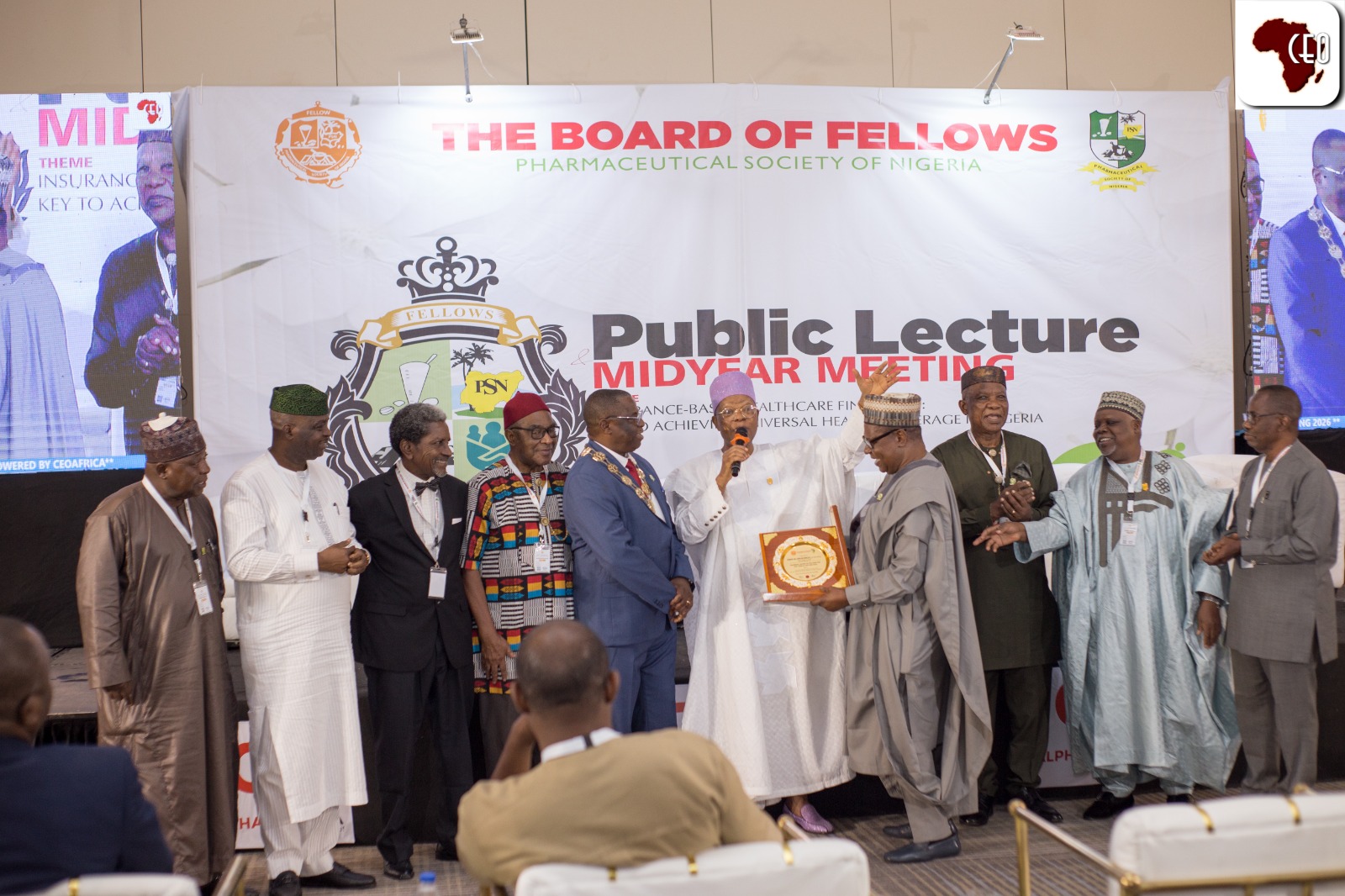
The call was made at the 2026 Public Lecture and Mid-Year Meeting of the Board of Fellows of the Pharmaceutical Society of Nigeria (BOF-PSN), held at the Marriott Hotel, Ikeja, Lagos. Participants urged governments, employers, professional associations and private organisations to accelerate health insurance enrolment, particularly among workers in the informal sector.
Speaking at the event, Chairman of the Board of Fellows, Pharm. Uchenna Uzoma Apakama, described Nigeria’s health insurance coverage as alarmingly low, revealing that only between five and eight per cent of the population is currently insured. He noted that traders, artisans, transport operators, market women and millions of other Nigerians remain exposed to catastrophic medical bills whenever illness strikes.
Apakama said the country’s poor insurance penetration continues to deepen poverty, as families are forced to finance healthcare through personal savings or borrowings. He stressed that affordable health insurance should no longer be viewed as a privilege but as a fundamental social protection tool and a key driver of national development.
The lecture, themed “Insurance-Based Healthcare Financing: Key to Achieving Universal Health Coverage in Nigeria,” brought together healthcare professionals, regulators, Health Maintenance Organisations (HMOs), financial institutions, government agencies and pharmaceutical stakeholders to explore practical solutions for achieving Universal Health Coverage (UHC).
Participants noted that despite more than two decades of health insurance reforms, Nigeria’s Universal Health Coverage index remains around 40, while over 70 per cent of healthcare spending is still financed through out-of-pocket payments by patients.
To expand coverage, Apakama urged members of the National Assembly to dedicate part of their constituency intervention funds to paying health insurance premiums for vulnerable Nigerians. He also encouraged labour unions, market associations, transport unions, professional bodies and community organisations to embrace group health insurance schemes, citing the National Association of Industrial Pharmacists of Nigeria (NAIP) as a successful example of collective enrolment.
He further challenged philanthropists, charitable foundations and corporate organisations to incorporate health insurance sponsorship into their Corporate Social Responsibility (CSR) programmes, insisting that protecting citizens’ health should be a shared responsibility between government and the private sector.
Chairman of the occasion and former Minister of Health, Prince Julius Adelusi-Adeluyi, urged Nigerians to place the same importance on protecting their health as they do on insuring valuable assets such as cars, houses and jewellery.
He expressed concern that many people willingly insure material possessions but neglect health insurance until serious illness leaves them financially devastated. Adelusi-Adeluyi observed that while countries such as Germany institutionalised health insurance centuries ago, Nigeria has continued to struggle because implementation has consistently lagged behind policy.
He called on pharmacists to become leading advocates for health insurance across the country, describing the profession as a critical pillar of Nigeria’s healthcare delivery system.
President of the Pharmaceutical Society of Nigeria (PSN), Pharm. Ayuba Tanko Ibrahim, reaffirmed the Society’s commitment to supporting healthcare reforms and positioning pharmacists as frontline drivers of health insurance expansion within communities.
This is another opportunity to own a faster-loading website to expand your business and take it digitally online. Meet the best website designer/master coder for any kind of website. Contact them now it is affordable Chat now: 09077260922
Delivering the keynote address on behalf of the Director-General of the National Health Insurance Authority (NHIA), Dr. Kelechi Ohiri, NHIA representative Pharm. Femi Adeoye said healthcare financing remains central to the transformation of Nigeria’s health sector.
According to him, Universal Health Coverage cannot be achieved unless financial barriers preventing citizens from accessing healthcare are removed. He explained that the Federal Government’s Renewed Hope Agenda is providing strategic direction for expanding health insurance while improving healthcare quality through enhanced provider accreditation, digital innovation and workforce development.
Adeoye added that the NHIA is deploying technology-driven systems to simplify enrolment and improve access to healthcare services nationwide.
Managing Director and Chief Executive Officer of Hygeia HMO, John Iwuajoku, disclosed that more than 130 million Nigerians currently lack any form of health insurance. He identified poor public awareness, inadequate government funding and weak healthcare infrastructure as major obstacles to achieving Universal Health Coverage.
He advocated integrating the National Identification Number (NIN) and Bank Verification Number (BVN) into health insurance enrolment processes to strengthen planning, improve data management and expand nationwide coverage.
President of the Nigeria Academy of Pharmacy, Prof. Lere Baale, called for the full integration of community pharmacists into Nigeria’s health insurance framework. He described community pharmacies as the country’s most accessible healthcare facilities and said they should serve as frontline providers under the national insurance programme.
Baale also advocated stronger collaboration among healthcare professionals to improve medication management and enhance patient outcomes.
A major highlight of the event was the unveiling of Ultimate Health HMO’s U-Health GIFSHIP (Group, Individual and Family Social Health Insurance Programme), designed to provide affordable health insurance for workers in the informal sector.
Managing Director of Ultimate Health HMO, Dr. Lekan Ewenla, said the initiative aims to close the healthcare access gap affecting traders, artisans, transport workers and small business owners who remain outside the formal insurance system.
He disclosed that although more than 11 million Nigerians currently benefit from the Federal Civil Service Health Insurance Programme, millions in the informal economy remain uninsured despite the 2022 amendment to the National Health Insurance Authority Act, which made health insurance mandatory for all Nigerians.
“Our goal is not simply to sell health insurance but to make quality healthcare more affordable, more accessible and more equitable for every Nigerian,” Ewenla said.
Head of Medical Services at Ultimate Health HMO, Dr. Chima Madu, explained that the package provides maternal and child healthcare, antenatal services, delivery care, neonatal services and cancer treatment support through NHIA-approved partnerships.
Representatives of the National Drug Law Enforcement Agency (NDLEA), the Nigerian Institution of Estate Surveyors and Valuers (NIESV), the Chartered Institute of Administration (CIA) and the Pharmacy Council of Nigeria (PCN) also pledged support for expanding health insurance coverage and strengthening healthcare financing.
The meeting ended with stakeholders reaffirming their commitment to shifting Nigeria’s healthcare financing system from heavy reliance on out-of-pocket spending to a sustainable insurance-driven model capable of protecting citizens from financial hardship while guaranteeing equitable access to quality healthcare.


Leave a Reply